
Ceramic Foam Filter
Ceramic foam filter (AL2O3 for aluminum) is a critical component in modern aluminum casting systems, designed to remove non-metallic inclusions and stabilize molten metal flow.
In real foundry production, many defects—such as inclusions, porosity, and poor surface finish—are directly related to unstable flow and insufficient filtration. A properly selected ceramic foam filter can significantly reduce these issues and improve overall casting quality.
AdTech ceramic foam filters are engineered to meet the demanding requirements of high-performance aluminum alloys, ensuring consistent filtration efficiency and stable casting results.
What Is a Ceramic Foam Filter?
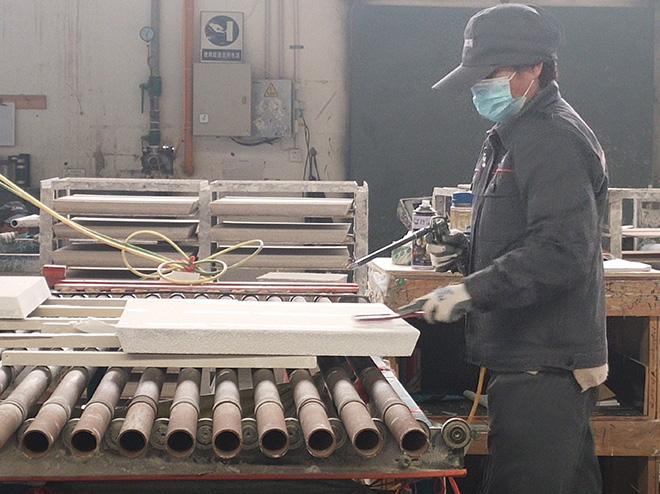
A Ceramic Foam Filter (CFF) is manufactured by impregnating a polyurethane foam template with alumina slurry, followed by drying and high-temperature sintering at approximately 1680°C.
During this process, the organic foam is burned out, leaving behind a rigid ceramic skeleton with a highly uniform, open-cell structure.
What Are the Material Properties of Alumina Ceramic Foam Filters?
The core material of the foam ceramic filter is high-purity alumina (Al₂O₃), which offers excellent performance under high-temperature casting conditions.
Key material advantages include:
- High temperature resistance (above 1180°C)
- Low thermal expansion, close to molten aluminum behavior
- Strong thermal shock resistance
- High mechanical strength and fracture toughness
Compared with other oxide ceramics, alumina provides better stability and durability in molten aluminum environments.
This is why alumina-based ceramic foam filters are widely used in aluminum casting, especially in applications requiring high reliability and consistent performance.
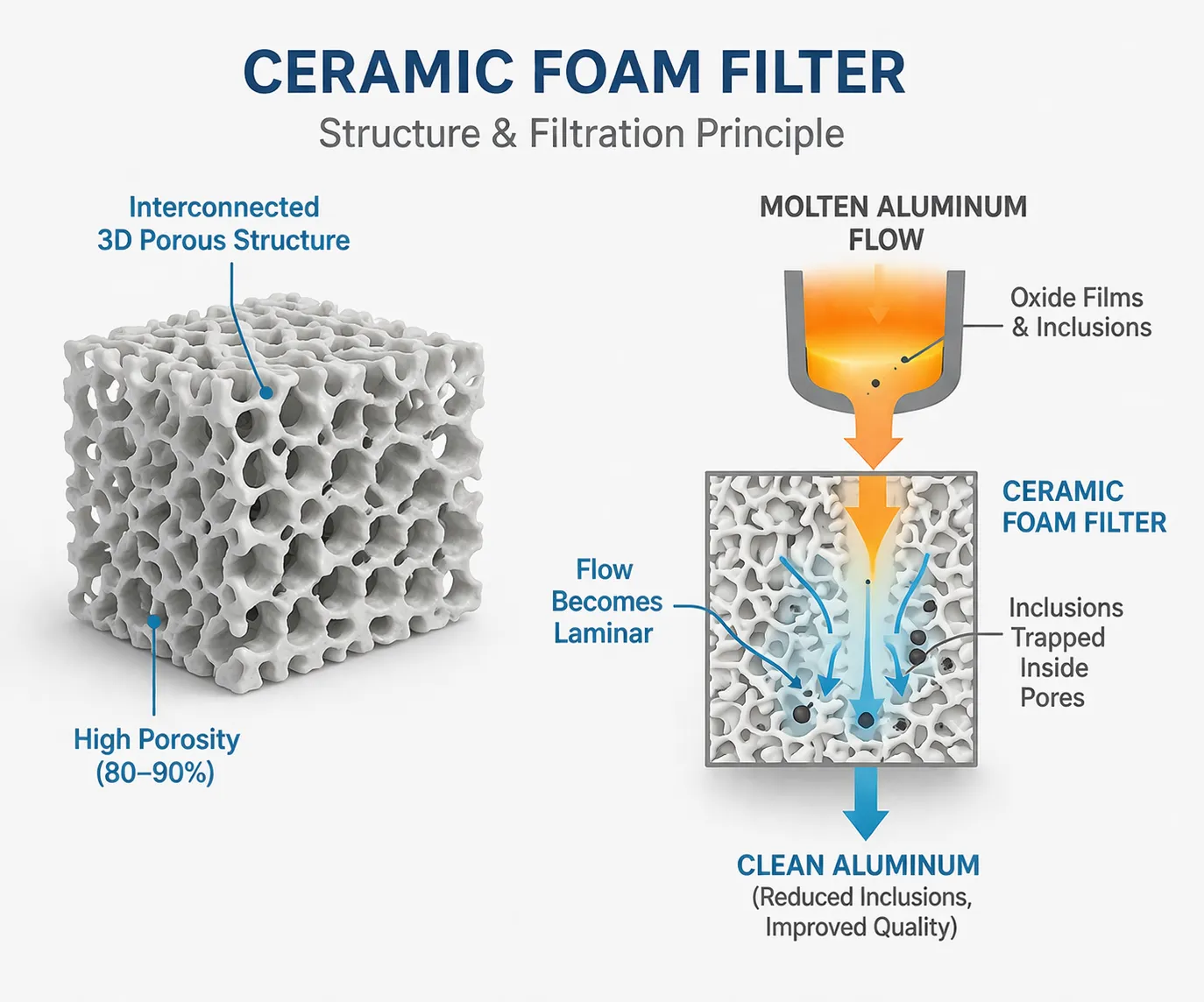
Key characteristics:
- Porosity: 80–90%
- Interconnected pore network
- High thermal shock resistance
Core functions in casting:
- Remove oxide films and inclusions
- Capture slag and impurities
- Stabilize molten metal flow
Unlike traditional mesh filters, ceramic foam filters use deep-bed filtration, meaning inclusions are trapped throughout the internal structure—not just on the surface. This is especially important for removing fine inclusions that often cause internal defects.
How Do Ceramic Foam Filters Improve Aluminum Casting Quality?
In real production environments, filtration does more than just clean the metal—it fundamentally changes flow behavior.
Table 1 – Casting Improvements with Ceramic Foam Filters
| Performance Indicator | Without Filter | With Ceramic Foam Filter |
|---|---|---|
| Inclusion content | High | Significantly reduced |
| Surface finish | Rough | Smooth |
| Scrap rate | 10–25% | Reduced by 15–40% |
| Mechanical properties | Unstable | Improved consistency |
Many defects in aluminum casting are caused by turbulence and oxide film entrainment. By smoothing flow, ceramic foam filters reduce these defects at the source—not just by filtering particles.
What Are the Key Specifications of Ceramic Foam Filters?
Table 2 –Technical Parameter
| Item | Density(g/cm³) | Rupture Modulus(816℃ /Mpa) | Comprehensive Strength(Mpa) | Operating Temperature(℃) | Sealing gasket expanding temperature (℃) |
|---|---|---|---|---|---|
| Index | 0.45 | 5. 5 | 0. 8-1.0 | 1550 | 450-550 |
The above data is obtained from controlled production processes and verified through factory quality inspection and testing.
Table 3 –Pore size Distribution
| Mesh Number(PPI) | 10 | 20 | 30 | 40 | 50 | 60 |
|---|---|---|---|---|---|---|
| Pore Density(PCS) | 8-12 | 18-22 | 28-32 | 38-42 | 48-52 | 58-62 |
These parameters ensure that the filter maintains structural stability under high-temperature molten aluminum while providing consistent filtration performance.
Table 4-Ceramic Foam Filter PPI Selection Guide
Selecting the correct PPI is one of the most critical decisions in filtration system design.
| PPI | Application | Characteristics |
|---|---|---|
| 10–20 PPI | Large castings | High flow, low resistance |
| 20–30 PPI | General casting | Balanced filtration |
| 30–50 PPI | Precision casting | Fine filtration |
| 50–60 PPI | Aerospace | Maximum cleanliness |
👉Tips:
Over 70% of aluminum foundries use 30 PPI or 40 PPI because it offers the best balance between filtration efficiency and flow rate.
⚠️ Common mistake:
Choosing higher PPI without adjusting flow conditions often leads to clogging and incomplete mold filling.
What Sizes and Flow Capacities Are Available for Ceramic Foam Filters?
Table 5 – Standard Sizes
| Size (inch) | Application |
|---|---|
| 7″ / 9″ | Small castings |
| 12″ | Standard aluminum casting |
| 15″–20″ | Large castings |
| Custom | Continuous casting |
👉Tips: If flow rate exceeds filter capacity, even correct PPI will fail—system design matters.
Why Is Flow Rate Critical When Selecting a Ceramic Foam Filter?
Many users focus only on PPI and ignore flow rate, which is one of the most common reasons for filtration failure.
Table 6 – Recommended Flow Rate per Filter Size
| Filter Size | Recommended Flow Rate (kg/min) |
|---|---|
| 7″ | 20–50 |
| 9″ | 25–80 |
| 12″ | 50–150 |
| 15″–20″ | 80–450 |
👉Tips: For high-flow systems, using multiple filters in parallel provides more stable performance than a single large filter.
What Is the Filtration Precision of Ceramic Foam Filters?
| Pore Size(PPI) | 20 | 30 | 40 | 50 | 60 |
| Inclusions Diameter(um) | 80 | 40 | 20 | 10 | 5 |
| Filtration Rate(%) | 78 | 85 | 88 | 92 | 95 |
👉Tips:Higher PPI provides finer filtration, but must be balanced with flow rate to avoid clogging.
Where Are Ceramic Foam Filters Used in Aluminum Casting Applications?
Ceramic foam filters are widely used in:
- Automotive aluminum castings
- Aerospace structural components
- Aluminum foil and rolling applications
- Electronic materials (PS plates, capacitor foils)
- High-performance industrial castings
They are especially critical in applications where internal cleanliness directly affects mechanical properties and reliability.
How Should Ceramic Foam Filters Be Installed and Used Properly?
Proper installation directly affects filtration performance.
Best practices:
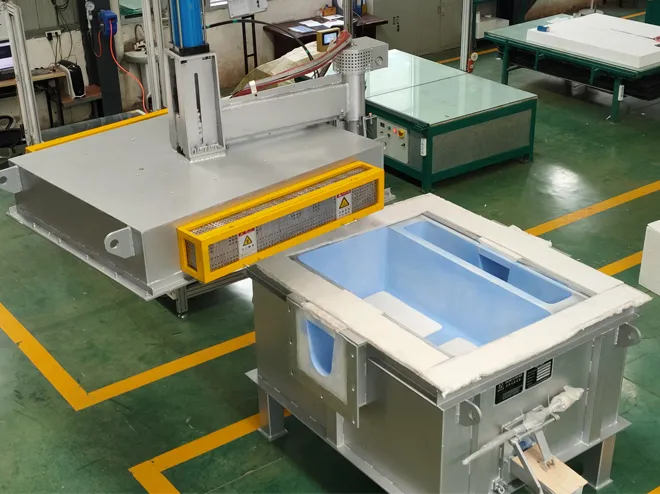
- Install in Plate Filtering Unit
- Ensure tight sealing to avoid bypass
- Avoid direct metal impact
- Match PPI with casting process
Preheating recommendations:
- ≥550°C for standard filters
- ≥650°C for high PPI filters
👉 Tips: Without proper preheating, molten aluminum may solidify inside the filter, leading to blockage or failure.
What Common Problems Occur When Using Ceramic Foam Filters and How to Fix Them?
Filter clogging
Cause: High PPI or contaminated melt
Solution: Lower PPI or improve melt treatment
Poor filtration performance
Cause: Incorrect installation or turbulence
Solution: Optimize gating system
Filter tilting or floating
Cause: Improper fixation
👉 Tips: Even a high-quality filter becomes ineffective if molten metal bypasses it.
How Do Ceramic Foam Filters Compare to Other Types of Filters?
| Type | Structure | Efficiency | Application |
|---|---|---|---|
| Ceramic Foam Filter | 3D porous | High | Aluminum casting |
| Mesh filter | 2D | Low | Basic filtration |
| Honeycomb filter | Channel | Medium | Controlled flow |
👉 Tips: Ceramic foam filters combine filtration + flow stabilization, making them the preferred solution.
How Can Ceramic Foam Filters Improve Casting Quality in Real Production Cases?
In early 2024, a mid-sized aluminum casting plant in Russia ordered 1,200 pieces of 30 PPI ceramic foam filters (12″ × 12″ × 2″) from AdTech for use in a gravity casting line.
Initial problem:
- High inclusion defects
- Scrap rate around 18%
- Inconsistent surface quality
Solution:
- Switched from 20 PPI to 30 PPI
- Optimized filter placement in runner
- Introduced proper preheating (≥600°C)
Results after 3 weeks:
- Scrap rate reduced to below 10%
- Surface finish significantly improved
- Filter consumption stabilized
👉 Key takeaway:
Performance improvement came not only from the filter itself, but from correct selection + system optimization.
Why Choose AdTech Ceramic Foam Filters for Aluminum Casting Applications?
As a professional ceramic foam filter manufacturer, we focus not only on product quality but also on real casting performance.
Our production is based on a stable manufacturing system, including:
- Controlled raw material selection (high-purity alumina)
- Automated slurry impregnation and coating process
- High-temperature sintering up to 1680°C
- Strict quality inspection before shipment
With years of production experience, our factory ensures that each filter maintains consistent pore structure, strength, and dimensional accuracy, which is critical for stable filtration performance in aluminum casting.
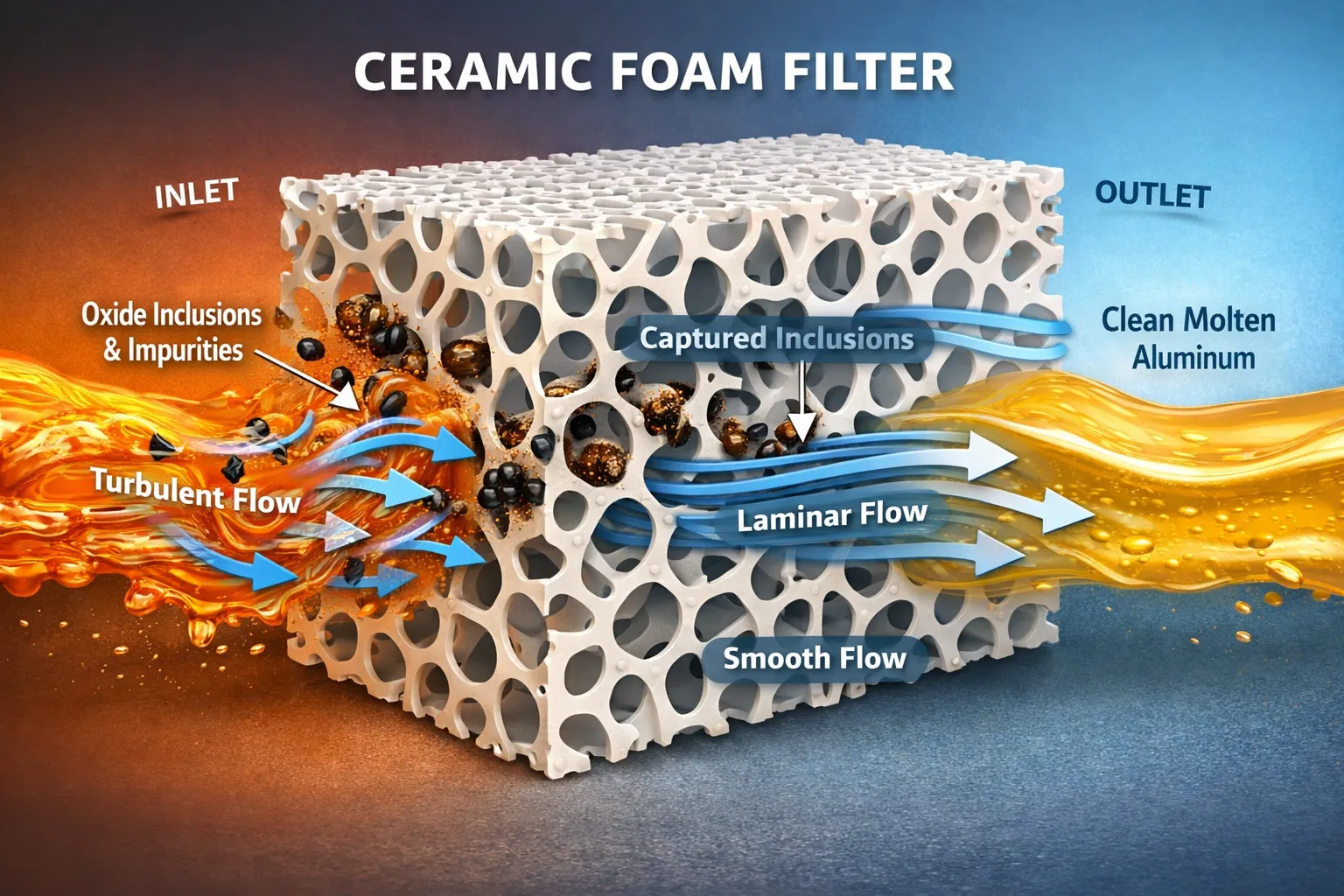
During the pouring process, molten aluminum tends to become turbulent, which increases the risk of oxide inclusions and defects. By passing through the three-dimensional pore structure of the ceramic foam filter, the flow is effectively transformed into a stable laminar flow.
This results in:
- More uniform mold filling
- Reduced turbulence and air entrainment
- Lower erosion of the mold cavity
- Improved casting integrity
👉 In practice, many casting defects are caused by unstable flow rather than material issues. A properly selected ceramic foam filter can significantly improve process stability.
We have supplied ceramic foam filters to customers in Russia, Southeast Asia, the Middle East, and many other regions worldwide, supporting applications from standard aluminum casting to high-performance alloy production.
If you are looking for a reliable filtration solution for aluminum casting, feel free to contact us for technical support and customized recommendations.
FAQ
1. What PPI ceramic foam filter should I use for aluminum casting?
For most applications, 30 PPI or 40 PPI is recommended. 20–30 PPI suits large castings, while 30–40 PPI offers balanced filtration and flow. Higher PPI is only used for high-purity requirements.
2. Is a higher PPI ceramic foam filter always better?
No. Higher PPI increases filtration precision but also raises flow resistance. If flow is too fast, the filter may clog or cause incomplete filling.
3. How do I choose the right ceramic foam filter size?
Filter size depends on flow rate, not just casting size. For high-flow systems, using multiple filters in parallel is often more effective.
4. What is the main function of a ceramic foam filter?
It removes non-metallic inclusions and stabilizes molten metal flow. In practice, flow control plays a major role in improving casting quality.
5. Can ceramic foam filters remove hydrogen or gas?
No. They only remove solid inclusions. Gas removal requires degassing equipment.
6. Why does my ceramic foam filter clog too quickly?
Common causes include high PPI, dirty melt, or excessive pouring speed. Reducing PPI and improving melt quality can solve this.
7. Do ceramic foam filters need preheating?
Yes. Preheating above 550°C is recommended to prevent metal solidification inside the filter.
8. Where should the filter be installed?
Typically in the runner system or a filter box. Avoid direct impact from molten metal.
9. Can ceramic foam filters be reused?
No. They are designed for single use. Reuse reduces efficiency and increases defect risk.
10. What is the most common mistake when using ceramic foam filters?
Choosing the wrong PPI and ignoring flow rate are the most common issues. Improper installation is another frequent problem.
