
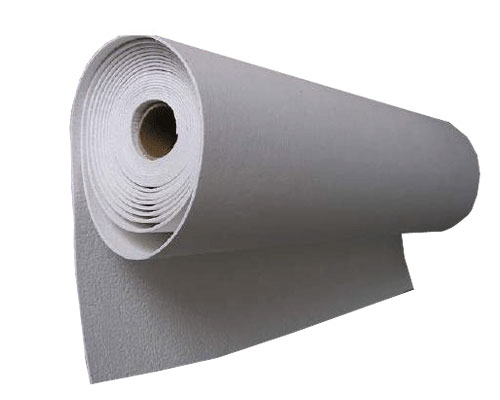
Ceramic fiber paper is a lightweight, flexible refractory sheet made from high-purity alumina-silica fibers, engineered to withstand continuous temperatures up to 1260°C (2300°F). It serves as a critical thermal barrier, gasket material, and lining insulation across aluminum casting, steel processing, and glass manufacturing. Unlike traditional refractory boards, ceramic fiber paper can be cut, wrapped, and formed to fit irregular surfaces — making it one of the most versatile insulation materials in high-temperature metalworking.
What Is Ceramic Fiber Paper Made Of?
Ceramic fiber paper is manufactured through a wet-forming process similar to traditional papermaking, but using inorganic refractory fibers instead of wood pulp. The base fibers — aluminum oxide (Al₂O₃) and silicon dioxide (SiO₂) — are blended with organic binders that burn off cleanly during first heat-up, leaving a pure, non-combustible insulation sheet.
The exact alumina-to-silica ratio determines the paper’s temperature grade. Standard-grade ceramic fiber paper typically contains around 47% Al₂O₃ and 53% SiO₂, suitable for applications up to 1050°C. High-purity grades push the alumina content above 55%, raising the continuous service temperature to 1260°C or higher.
Most manufacturers add a small percentage of organic binder (usually 5–10% by weight) to give the paper handling strength before installation. This binder burns out between 300–400°C, which means the paper becomes slightly more brittle after its first thermal cycle — something to factor in if you’re planning to remove and reposition it.
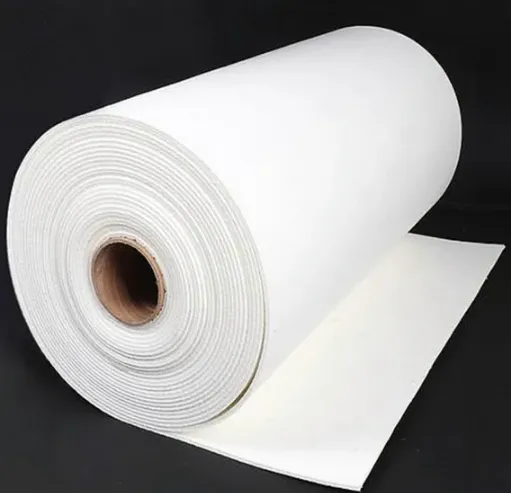
A key distinction worth noting: ceramic fiber paper is not the same as ceramic fiber blanket or ceramic fiber board. The paper is thinner (typically 0.5 mm to 6 mm), denser, and has a smoother surface finish. It’s designed for precision applications where blanket would be too thick or too loose-fitting.
| Property | Standard Grade (1050°C) | High-Purity Grade (1260°C) | HP-Z Grade (1430°C) |
|---|---|---|---|
| Al₂O₃ Content | 44–47% | 52–55% | 35–40% (+ ZrO₂) |
| SiO₂ Content | 53–56% | 45–48% | 40–45% |
| ZrO₂ Content | — | — | 15–20% |
| Continuous Use Temp | 1050°C / 1922°F | 1260°C / 2300°F | 1430°C / 2600°F |
| Density | 160–190 kg/m³ | 180–210 kg/m³ | 200–240 kg/m³ |
| Thermal Conductivity (600°C) | 0.08–0.10 W/m·K | 0.09–0.11 W/m·K | 0.10–0.12 W/m·K |
| Organic Binder Content | 5–8% | 5–8% | 5–8% |
Data aligned with classifications per ASTM C892 Standard Specification for High-Temperature Fiber Blanket Thermal Insulation. Exact values vary by manufacturer and lot.
If your project requires the use of Ceramic Foam Filter, you can contact us for a free quote.
Why Use Ceramic Fiber Paper Instead of Traditional Refractory Gaskets?
I’ve seen plant engineers default to compressed asbestos-free gaskets or graphite sheets for high-temperature sealing, and in many cases those materials work fine — up to a point. The problem shows up when you’re dealing with temperatures above 800°C, molten metal splash zones, or joints that need to accommodate thermal expansion without cracking.
Ceramic fiber paper handles all three. It compresses under bolt load to fill surface imperfections, it won’t melt or degrade at casting temperatures, and it doesn’t become rigid after thermal cycling the way calcium silicate boards do.
In aluminum foundries specifically, ceramic fiber paper sees heavy use as:
- Launder and trough lining — a sacrificial layer between the refractory and molten aluminum to prevent sticking and simplify cleanup
- Gasket material between mating flanges on transfer ladles, degassing units , and ceramic foam filters housings
- Backup insulation behind castable refractory to reduce heat loss through furnace shells
- Mold release and separator sheets in investment casting and die casting operations
- Expansion joint filler in kiln and furnace construction to absorb thermal growth without structural stress
One thing that doesn’t get mentioned often enough: ceramic fiber paper also functions as an effective electrical insulator at elevated temperatures. Its dielectric strength makes it useful in induction furnace coil wrapping and thermocouple sheathing — applications where both heat resistance and electrical isolation matter simultaneously.
If your project requires the use of Ceramic Foam Filter, you can contact us for a free quote.
How Thick Should Ceramic Fiber Paper Be for Aluminum Casting?
Thickness selection depends on the specific function. Here’s what actually works in practice, based on field installations across aluminum smelters and secondary casting operations:
For gaskets and seals (launder joints, filter box flanges): 2–3 mm is the standard. Thinner paper (1 mm) doesn’t provide enough compression to seal uneven mating surfaces. Thicker paper (5–6 mm) works for rough flanges but can compress unevenly under bolt load if the fastening pattern isn’t tight enough.
For lining and wrapping (trough interiors, ladle walls): 3–6 mm gives a useful insulating layer without taking up too much of the interior cross-section. In applications where the paper sits behind a primary refractory layer, even 1–2 mm adds measurable thermal benefit because it interrupts direct conduction paths.
For expansion joints: Match the paper thickness to the calculated thermal expansion of the refractory. For a 3-meter furnace wall operating at 1000°C, you’re typically looking at 4–6 mm of expansion joint filler per joint.
For filtration backing and sealing in CFF (ceramic foam filter) systems: 2 mm is typical. The paper creates a tight seal around the Plate Filtering Unit perimeter, preventing molten aluminum from bypassing the filter — which is the single most common cause of inclusion defects traced back to the filtration stage.
| Application | Recommended Thickness | Temperature Range | Key Performance Requirement |
|---|---|---|---|
| Launder joint gasket | 2–3 mm | 680–750°C | Compression & seal integrity |
| Trough lining (sacrificial layer) | 3–6 mm | 700–760°C | Non-wetting, easy strip-out |
| Filter box seal (CFF system) | 1.5–2 mm | 700–740°C | Bypass prevention, conformability |
| Expansion joint filler | 3–6 mm | Up to 1260°C | Compressibility, thermal stability |
| Furnace backup insulation | 2–6 mm | 800–1200°C | Low thermal conductivity |
| Induction coil wrapping | 0.5–1 mm | 200–600°C | Dielectric strength, flexibility |
Thickness recommendations based on field data from aluminum casting and remelting operations. Actual selection should account for specific equipment geometry and operating conditions.
Does Ceramic Fiber Paper React with Molten Aluminum?
This is a legitimate concern, and the short answer is: it depends on the grade and exposure conditions.
Standard alumina-silica ceramic fiber paper is non-wetting to molten aluminum under normal casting conditions (680–750°C). The aluminum doesn’t bond to or soak into the fiber matrix the way it would with uncoated steel or porous calcium silicate. That’s exactly why it works so well as a sacrificial trough lining — after a casting campaign, you peel off the used paper and the underlying refractory is clean.
However, at extended contact times or higher temperatures (above 900°C), molten aluminum can begin to reduce the silica component in the fiber:
4Al + 3SiO₂ → 2Al₂O₃ + 3Si
This reaction is thermodynamically favorable and produces free silicon that contaminates the melt. In aluminum casting, where silicon specs can be tight (especially for electrical conductor grade or aerospace alloys), this matters.
The practical implication: for short-contact applications like launder lining and gaskets, standard ceramic fiber paper is fine. For continuous-immersion applications — say, a permanent thermocouple sheath sitting in a holding furnace — you’d want a high-alumina grade or a coated paper with a boron nitride or colloidal silica surface treatment to limit the reduction reaction.
In our experience working with aluminum rod and billet producers, the standard grade paper holds up well through a typical casting sequence (4–8 hours of metal contact) without measurable silicon pickup in the melt. Problems tend to emerge only when paper is reused across multiple campaigns without replacement — which is a maintenance practice issue, not a material limitation.
Request A Quote
What Temperature Can Ceramic Fiber Paper Withstand?
The maximum service temperature of ceramic fiber paper ranges from 1050°C to 1430°C, depending on the chemical composition:
- Standard grade (1050°C): Adequate for most aluminum and zinc processing, general industrial gasketing, and appliance insulation.
- High-purity grade (1260°C): The workhorse for ferrous foundries, heat treatment furnaces, and petrochemical applications. This is the grade most commonly specified in aluminum casting operations where temperatures stay below 800°C but you want a safety margin.
- Zirconia-bearing grade (1430°C): Required for steel ladle applications, glass melting, and any service above 1300°C. The addition of 15–20% ZrO₂ dramatically improves shrinkage resistance at extreme temperatures.
An important distinction: “maximum service temperature” means the paper will survive indefinitely at that temperature without excessive shrinkage or fiber devitrification. You can expose it to brief temperature excursions 100–150°C above the rated limit without catastrophic failure, but sustained operation above the rating will cause the fibers to crystallize into mullite or cristobalite — hard, brittle phases that destroy the paper’s flexibility and insulating value.
Thermal conductivity is the other critical number, and it’s where ceramic fiber paper genuinely outperforms denser refractory materials. At 400°C, a 3 mm sheet of ceramic fiber paper provides roughly the same insulating value as 10–12 mm of dense calcium silicate board. That’s a significant space saving in compact equipment like degassing systems or inline filter assemblies where every millimeter of internal volume matters.
How to Cut and Install Ceramic Fiber Paper Correctly
Ceramic fiber paper can be cut with standard tools — scissors, utility knives, or die-cutting machines for production quantities. A few practical tips that save time and waste:
Cutting: Use a sharp blade and cut against a flat surface. Dull blades tear the fibers instead of cutting them, leaving ragged edges that don’t seal well. For circular gaskets, a compass cutter works better than tracing and hand-cutting. If you’re cutting large quantities of identical shapes, ask your supplier about custom die-cut parts — most manufacturers including our team can supply pre-cut gaskets and shapes to your drawings.
Handling: Wear gloves. Ceramic fiber paper is classified as a synthetic vitreous fiber, and while it’s far less hazardous than asbestos, the fine fibers can cause skin irritation. A dust mask is recommended when cutting, especially in enclosed spaces. Follow OSHA guidelines for synthetic mineral fibers regarding workplace exposure limits.
Installation as gaskets: Dry-fit first. The paper should extend to the full bolt circle without overlapping bolt holes. For flanged joints, don’t over-torque — ceramic fiber paper compresses to about 30–40% of its original thickness under typical bolt loads, and excessive compression destroys the insulating air pockets that give it thermal value.
Installation as lining: Apply to clean, dry surfaces. For vertical or overhead applications, use a high-temperature adhesive (sodium silicate-based) or mechanical pins to hold the paper in place until the first heat-up. After the organic binder burns out, the paper is held in position by the surrounding structure.
Layering: Multiple layers of thin paper sometimes outperform a single thick sheet. Two layers of 2 mm paper with a slight offset provide better insulation than one 4 mm layer because the interface between layers interrupts heat conduction. This is a trick borrowed from kiln construction that works well in launder design too.
Ceramic Fiber Paper vs. Ceramic Fiber Blanket: Which One Do You Need?
This is one of the most common questions we get from customers specifying insulation for new casting lines or furnace rebuilds. The answer depends on the application geometry and performance requirements.
| Feature | Ceramic Fiber Paper | Ceramic Fiber Blanket |
|---|---|---|
| Thickness Range | 0.5–6 mm | 6–50 mm |
| Density | 160–240 kg/m³ | 64–160 kg/m³ |
| Surface Finish | Smooth, uniform | Fibrous, textured |
| Flexibility | High (can wrap tight radii) | High (but bulkier) |
| Cutting Precision | Excellent — clean edges | Good — tends to fray |
| Gasket/Seal Use | Yes — primary application | No — too compressible and uneven |
| Bulk Insulation | Limited by thickness | Yes — primary application |
| Typical Use in Casting | Gaskets, liners, wraps | Furnace wall insulation, ladle covers |
| Cost per m² (comparable thickness) | Higher | Lower |
Comparison based on standard alumina-silica grades. Specialty compositions (high-alumina, zirconia-bearing) available in both forms.
In a typical aluminum casting line, you’ll use both. Ceramic fiber blanket goes behind the structural refractory in the melting and holding furnaces — 50 mm or even 75 mm thick — to minimize shell temperature and energy loss. Ceramic fiber paper goes at the joints, transitions, and contact surfaces where precision fit and smooth texture matter.
Think of it this way: blanket is for volume insulation, paper is for precision insulation. They’re complementary, not interchangeable.
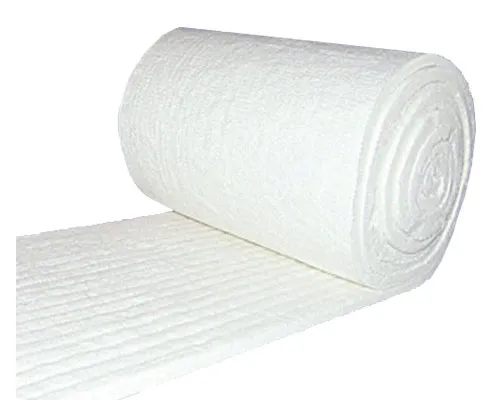
How to Store Ceramic Fiber Paper to Maintain Performance
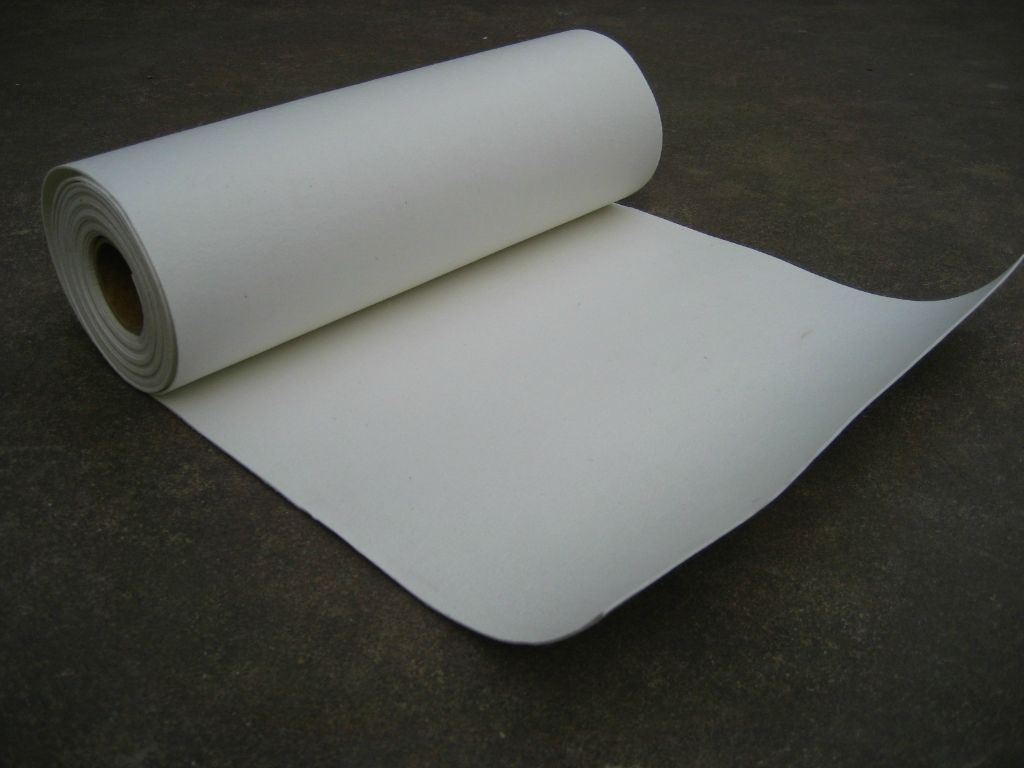
Ceramic fiber paper is hygroscopic — it absorbs moisture from the air, which weakens the organic binder and reduces handling strength. A roll that’s been sitting on an open warehouse shelf in a humid climate for six months will tear and crumble when you try to unroll it.
Best practice:
- Store in the original sealed polyethylene wrap until ready for use
- Keep off concrete floors (use pallets or shelving) to avoid moisture wicking
- Ideal storage conditions: below 30°C, below 60% relative humidity
- Shelf life in sealed packaging: 24 months minimum
- Once opened, use within 3 months or reseal with vapor barrier tape
If you receive paper that feels damp or shows visible discoloration (brown spots from binder degradation), it’s still usable — the binder will burn out during first heat-up anyway — but it will be more difficult to cut cleanly and may not hold its shape during installation. For critical gasket applications, use fresh stock.
Ceramic Fiber Paper Specifications and Ordering
When specifying ceramic fiber paper for procurement, include these parameters:
- Temperature grade (1050°C, 1260°C, or 1430°C)
- Thickness (0.5 mm, 1 mm, 2 mm, 3 mm, 5 mm, 6 mm are standard)
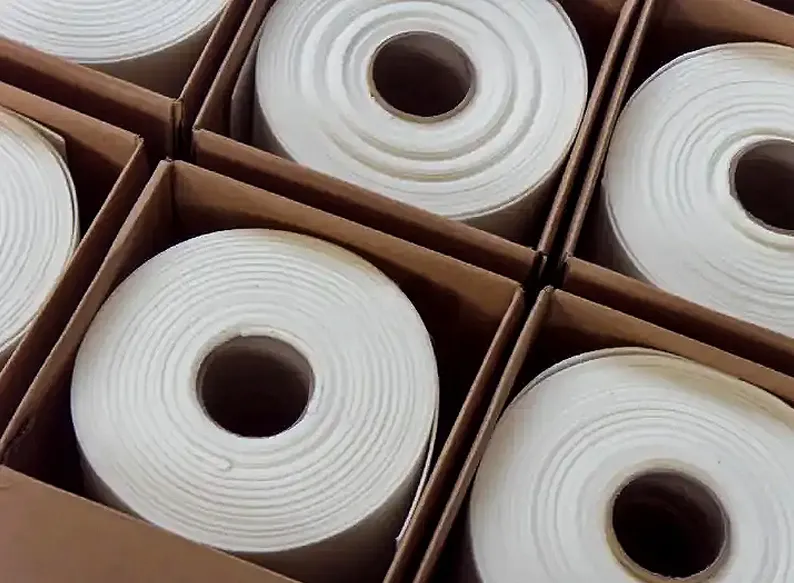
- Sheet or roll format (standard rolls are 610 mm wide × 25–40 m long; sheets are typically 610 × 915 mm)
- Custom die-cutting requirements if ordering gaskets or specific shapes
- Quantity — most suppliers have minimum order quantities of 20–50 kg for stock sizes
For aluminum casting applications specifically, we generally recommend high-purity grade (1260°C rated) in 2–3 mm thickness as the default starting point. It costs marginally more than standard grade but provides significantly better dimensional stability through repeated thermal cycles — and in a production environment, dimensional stability translates directly into consistent sealing and fewer unplanned shutdowns.
If you’re unsure which grade and thickness suit your application, our technical team can review your equipment drawings and operating conditions to make a specific recommendation. We stock a full range of ceramic fiber paper alongside our castertip and hot top product lines, so consolidated shipments keep your freight costs reasonable.
| Specification | Standard Option | Notes |
|---|---|---|
| Temperature Rating | 1050 / 1260 / 1430°C | Specify based on maximum operating temperature + safety margin |
| Thickness | 0.5 – 6 mm | 2–3 mm most common for aluminum casting gaskets |
| Roll Width | 610 mm (24 in) | Other widths available on request |
| Roll Length | 25 m or 40 m | Longer rolls reduce waste on large lining jobs |
| Color (as-supplied) | White | May yellow slightly after binder burn-out — normal |
| Certification | ASTM C892, ISO 10635 | Request mill test certificates for critical applications |
Ordering specifications for standard ceramic fiber paper products. Custom compositions, coatings (boron nitride, colloidal silica), and die-cut shapes available with minimum order quantities. Contact our sales team for lead times.
Selecting the Right Insulation for Your Casting Line
Ceramic fiber paper fills a specific niche in the broader landscape of high-temperature insulation materials. It’s not the cheapest option per square meter — calcium silicate board and standard refractory blanket undercut it on raw material cost. But when you factor in installation labor, replacement frequency, and the downstream quality impact of proper sealing and insulation, it consistently delivers the lowest total cost of ownership in precision applications.
The aluminum industry in particular has shifted heavily toward ceramic fiber paper over the past two decades, driven by tightening inclusion specifications from automotive and aerospace end-users. A gasket failure at the filter box doesn’t just waste a filter — it contaminates an entire cast, potentially scrapping several tons of finished billet or slab. At current LME aluminum prices, even a single bypass event can cost more than a year’s supply of properly specified ceramic fiber paper gaskets.
That’s the calculation that matters. Not the per-unit cost of the paper, but the cost of what happens when it fails — or when you use the wrong material in its place.
If you’re evaluating ceramic fiber paper for a new installation or looking to improve an existing casting line, reach out to our team with your specific application details. We’ve supplied ceramic fiber insulation products, flow control components, and filtration systems to aluminum producers across 40+ countries, and practical application experience is where we add the most value beyond the product itself.
FAQ
1. What is ceramic fiber paper used for?
Ceramic fiber paper is used as high-temperature gasket material, thermal insulation lining, expansion joint filler, and molten metal separator in aluminum casting, steel processing, and furnace construction.
2. What temperature can ceramic fiber paper withstand?
Standard grade handles up to 1050°C (1922°F), high-purity grade up to 1260°C (2300°F), and zirconia-bearing grade up to 1430°C (2600°F) in continuous service.
3. Is ceramic fiber paper the same as ceramic fiber blanket?
No. Ceramic fiber paper is thinner (0.5–6 mm), denser, and smoother than blanket. Paper is for precision gaskets and liners; blanket is for bulk furnace insulation.
4. Can ceramic fiber paper be used with molten aluminum?
Yes. It is non-wetting to molten aluminum at normal casting temperatures (680–750°C) and works well as launder lining and filter box gaskets.
5. How do you cut ceramic fiber paper?
Use sharp scissors, a utility knife, or a die-cutting machine. Cut against a flat surface to avoid tearing the fibers. Wear gloves and a dust mask during cutting.
6. Does ceramic fiber paper contain asbestos?
No. Ceramic fiber paper is made from synthetic alumina-silica fibers and contains no asbestos.
7. How thick should ceramic fiber paper be for gaskets?
For most aluminum casting gasket applications, 2–3 mm thickness provides the best balance of compression and seal integrity.
8. How long does ceramic fiber paper last in service?
In aluminum casting gasket applications, properly installed ceramic fiber paper typically lasts 8–10 casting campaigns before replacement is needed.
9. Is ceramic fiber paper safe to handle?
It can cause minor skin irritation from loose fibers. Follow OSHA synthetic mineral fiber guidelines — wear gloves and use respiratory protection when cutting.
10. How should ceramic fiber paper be stored?
Keep it sealed in original packaging, off concrete floors, below 30°C and 60% relative humidity. Use within 3 months after opening.